Videos
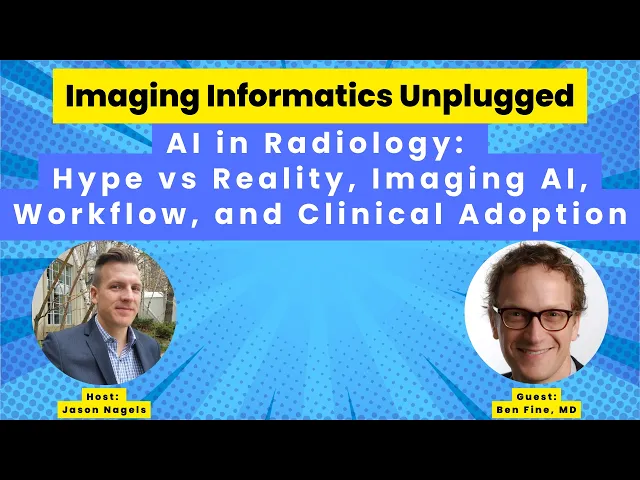
AI in Radiology: Hype vs Reality. Imaging AI. Workflow. and Clinical Adoption | Dr. Ben Fine
Is radiology AI finally living up to the hype — or are we still waiting for the revolution Geoff Hinton promised back in 2012? In this episode of Imaging Informatics Unplugged, Jason sits down with Dr. Ben Fine, a radiologist with a deep background in imaging informatics, AI deployment, and enterprise imaging strategy.
AI in Radiology: Hype vs Reality. Imaging AI. Workflow. and Clinical Adoption | Dr. Ben Fine
Ben shares a refreshingly honest take on where radiology AI actually stands today: only about 1% of imaging workflows are meaningfully augmented by AI tools, and real ROI is still rare — driven more by FOMO than outcomes. But he argues the corner is being turned, as the field shifts from narrow deep learning models to foundation models capable of assisting with full radiology reports.
The conversation digs into real-world AI deployment lessons from the AIDE Lab at Trillium Health Partners, where Ben’s team developed a pre-deployment evaluation methodology for PACS-integrated AI tools that has since become best practice. They also explore the Swiss cheese model of human-AI collaboration, why operational workflow use cases (such as protocol automation and procedure nomenclature mapping) often outperform flashy diagnostic AI for ROI, and what effective AI governance looks like for health systems.
Whether you’re a PACS Admin, Imaging Manager, Radiologist, or Healthcare IT professional thinking about enterprise imaging and AI in radiology, this episode is packed with practical, colleague-to-colleague insights.
Learn more at nagelsconsulting.com
KEY TOPICS COVERED
• Amara’s Law and the realistic 3-year outlook for radiology AI — why we’re finally at the inflection point after years of overhype
• The AIDE Lab at Trillium Health: how pre-deployment evaluation of PACS-integrated AI tools became a best-practice framework across Ontario
• The Swiss cheese model of human-AI collaboration — why AI and radiologists fail in such different ways, and how to design systems that catch what neither misses alone
• Operational AI use cases that deliver real ROI: procedure nomenclature mapping, CT/MRI protocol automation, and bone mineral density (BMD) workflow assistance
• AI governance frameworks for health systems — applying a pharmaceutical-committee model to the selection, validation, deployment, and monitoring of AI tools
• The future skills that matter: why domain expertise combined with AI fluency — not just soft skills — will define the next generation of imaging informatics professionals
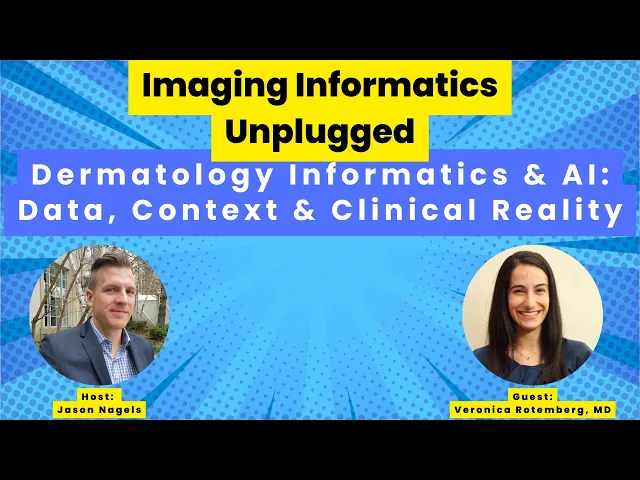
Dermatology Imaging Informatics & AI: Data, Context and Clinical Reality | Dr. Veronica Rotemberg
Artificial intelligence is rapidly entering dermatology — but what does it actually take to make AI work in real clinical practice?
In this episode of Imaging Informatics Unplugged, Jason Nagels sits down with Dr. Veronica Rotemberg, Director of Dermatology Informatics and Research at Memorial Sloan Kettering Cancer Center, to explore how dermatology is navigating AI, data quality, and real-world implementation challenges.
Dermatology is one of the most image-driven specialties in medicine, yet its imaging workflows have evolved very differently from those in radiology and pathology. As AI models promise improved diagnostic performance, new questions emerge around benchmarking, overfitting, clinical context, and bias.
Dermatology Imaging Informatics & AI: Data, Context and Clinical Reality | Dr. Veronica Rotemberg
In this conversation, we cover:
• Why AI became a forcing function for dermatology informatics
• The limits of single-image benchmarking and reader studies
• The “ugly duckling” concept in melanoma detection
• Overfitting risks from lighting, markers, camera differences, and workflow artifacts
• Skin tone bias in AI models and why labelling is harder than it sounds
• Why testing AI in its intended clinical use setting is critical
Dr. Rotemberg holds a PhD in Biomedical Engineering, leads an NIH-funded AI and informatics research lab, chairs the Augmented Intelligence Committee of the American Academy of Dermatology, and serves on the Board of Directors of the Society for Imaging Informatics in Medicine.
If you’re interested in enterprise imaging, clinical AI validation, dermatology informatics, or bias in machine learning, this episode delivers a grounded, clinician-informed perspective.
🔔 Subscribe for more deep conversations on imaging informatics, AI in healthcare, enterprise imaging, DICOM, FHIR, and real-world clinical systems.
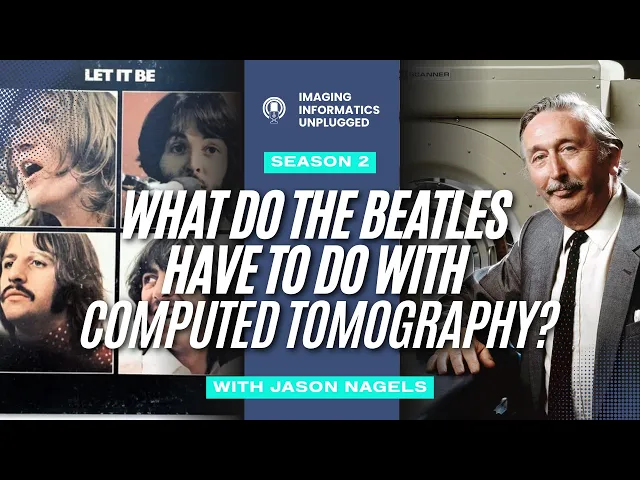
The Beatles. EMI. and the Birth of CT Scanning | Imaging Informatics Unplugged | Nagels Consulting
What do The Beatles have to do with the invention of the CT scanner?
The Beatles. EMI. and the Birth of CT Scanning | Imaging Informatics Unplugged | Nagels Consulting
At first glance… nothing.
By the time CT scanning was introduced in the early 1970s, The Beatles had already broken up. But the connection between one of the most influential bands in history and one of the most important technologies in modern medicine runs through a company called EMI.
In this episode, we explore the surprising story of how revenue generated by Beatles records helped sustain the research division at EMI where Godfrey Hounsfield developed the first computed tomography (CT) scanner.
We also explore how CT imaging transformed diagnostic medicine and how the field of imaging informatics helps manage imaging safely today.
Topics covered include:
• The invention of CT scanning
• The role of EMI and Godfrey Hounsfield
• The first clinical CT brain scan in 1971
• Ionizing radiation and medical imaging
• Radiation safety principles like ALARA
• The Cedars-Sinai CT dose incident
• Standards such as DICOM Radiation Dose Structured Reports (RDSR)
• Regional and national dose registries
Medical imaging has revolutionized healthcare, allowing clinicians to see inside the body with unprecedented clarity. But the story behind these technologies sometimes has unexpected connections to music, culture, and history.
And in this case… it starts with The Beatles.
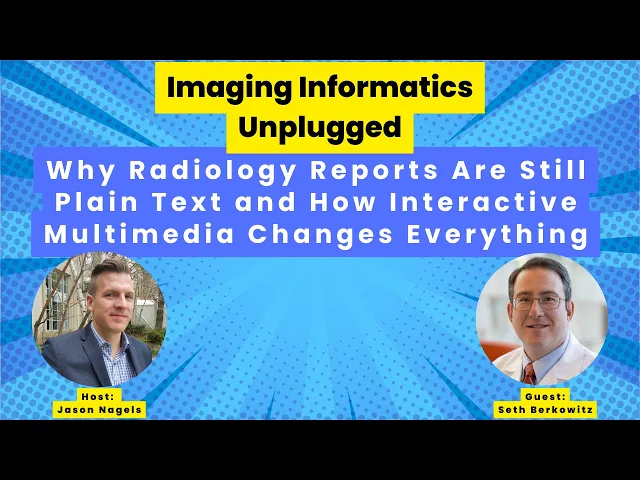
Interactive Multimedia Reporting: Standards, AI, & the Future of Reporting | Dr. Seth Berkowitz
In this episode of Imaging Informatics Unplugged, we explore Interactive Multimedia Reporting (IMR) and why traditional text-based radiology reports are no longer enough for image-driven clinical care.
Interactive Multimedia Reporting: Standards, AI, & the Future of Reporting | Dr. Seth Berkowitz
I’m joined by Seth Berkowitz, interventional radiologist, clinical informaticist, and Medical Director of Radiology Informatics at Beth Israel Deaconess Medical Center. Seth led the HIMSS–SIIM whitepaper work defining the technical challenges of vendor-neutral, interoperable multimedia reporting and is deeply involved in RSNA and IHE reporting standards.
We discuss:
• What Interactive Multimedia Reporting actually is (and what it isn’t)
• Why most IMR implementations remain vendor-specific
• The role of IHE profiles, FHIR, and DICOM in enabling interoperability
• Real-world barriers to adoption, including workflow and reporting time
• How AI and structured reporting could finally make IMR scalable
• Why reports should behave more like modern digital tools, not static text
This conversation is for radiologists, imaging informatics professionals, CIIPs, vendors, and health IT leaders who care about clarity, interoperability, and the future of imaging communication.
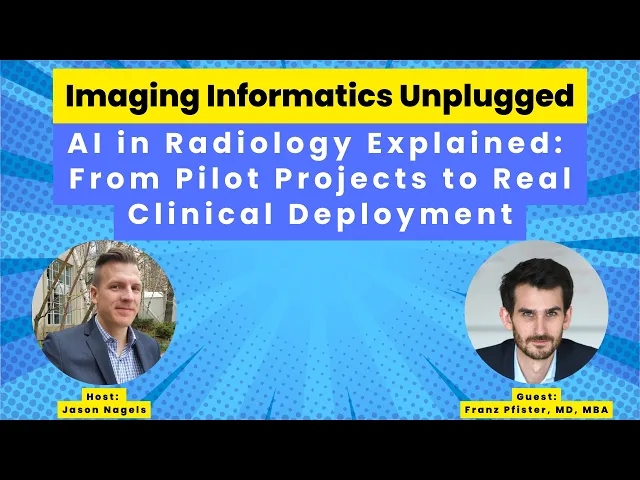
AI in Radiology Explained: From Pilot Projects to Real Clinical Deployment | Dr. Franz Pfister
AI in healthcare is everywhere — but very little of it actually works in real clinical environments.
AI in Radiology Explained: From Pilot Projects to Real Clinical Deployment | Dr. Franz Pfister
In this episode of Imaging Informatics Unplugged, Jason Nagels sits down with Dr. Franz Pfister, physician, data scientist, and CEO of deepc, to discuss what it really takes to operationalize AI in radiology and healthcare workflows.
They explore why model accuracy alone isn’t enough, how hospitals deploy AI safely at scale, and what separates real operational AI from marketing hype.
If you work in enterprise imaging, radiology, PACS, VNA, healthcare IT, or clinical AI, this conversation is essential.
⸻
What You’ll Learn
• Why most healthcare AI pilots never become operational
• The difference between model performance and workflow integration
• How AI is deployed safely inside clinical environments
• Privacy, governance, and regulatory challenges (GDPR, AI Act)
• Performance drift and real-world AI reliability
• Agentic AI in healthcare: hype vs reality
• How AI will reshape roles in radiology and imaging informatics
• Treating AI as infrastructure, not just a tool
About the Guest
Dr. Franz MJ Pfister is a medical doctor, data scientist, and entrepreneur working at the intersection of AI, healthcare, and clinical operations. He studied medicine at Ludwig Maximilian University of Munich and Harvard Medical School, holds a doctorate in neuroscience, an MBA, and a Master’s in Data Science. He is CEO and co-founder of deepc, a company focused on operational AI infrastructure for radiology.
⸻
About Imaging Informatics Unplugged
Imaging Informatics Unplugged explores enterprise imaging strategy, interoperability, PACS, VNA, clinical workflows, healthcare AI, and the future of medical imaging technology.
Hosted by Jason Nagels of Nagels Consulting.
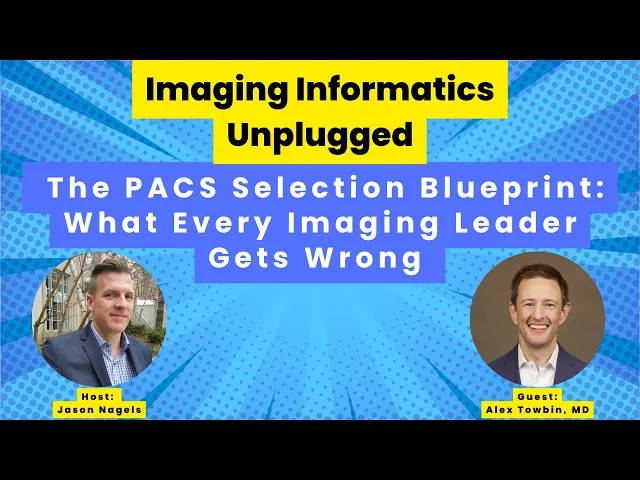
The PACS Selection Blueprint: What Every Imaging Leader Gets Wrong | with Dr. Alex Towbin
Choosing a PACS can shape the next 10 years of your imaging department. Yet many leaders still rely on gut feel, vendor hype, or checklists that do not reflect real clinical operations. In this episode of Imaging Informatics Unplugged, I sit down with Dr. Alex Towbin, Professor of Radiology and the Neil D. Johnson Chair of Radiology Informatics at Cincinnati Children’s Hospital, to break down the complete PACS selection process behind his team’s widely referenced study. 
The PACS Selection Blueprint: What Every Imaging Leader Gets Wrong | with Dr. Alex Towbin
We cover every stage of the journey. The politics, the data, the shortcomings of vendor demos, and the real-world constraints that most hospitals underestimate. Dr. Towbin explains how his team evaluated ten PACS vendors, how they neutralized bias in the committee, why radiologists often stay attached to their first PACS, and what PACS 3.0 will require as AI-driven workflows mature.
If you are a PACS admin, enterprise imaging strategist, IT architect, radiology leader, or anyone preparing for an upcoming procurement, this episode will give you a clear and practical blueprint to follow.
📝 Read the full published paper
https://link.springer.com/article/10....
⸻
In This Episode
• How Cincinnati Children’s designed a transparent and data-focused PACS selection process
• Why radiologists become “imprinted” on their first PACS and how that shapes department culture
• The hidden cost of switching PACS and why minor improvements may not justify a complete replacement
• How real anonymized data exposed major weaknesses in vendor demos
• What to expect in the shift toward PACS 3.0 with AI-enabled and automated workflows
• Why database access, technologist workflows, and support models often matter more than shiny features
• How to scale your procurement approach based on the impact of the system
• What imaging leaders should rethink heading into their next PACS evaluation cycle
AI in Radiology: Hype vs Reality. Imaging AI. Workflow. and Clinical Adoption | Dr. Ben Fine
Is radiology AI finally living up to the hype — or are we still waiting for the revolution Geoff Hinton promised back in 2012? In this episode of Imaging Informatics Unplugged, Jason sits down with Dr. Ben Fine, a radiologist with a deep background in imaging informatics, AI deployment, and enterprise imaging strategy.
AI in Radiology: Hype vs Reality. Imaging AI. Workflow. and Clinical Adoption | Dr. Ben Fine
Ben shares a refreshingly honest take on where radiology AI actually stands today: only about 1% of imaging workflows are meaningfully augmented by AI tools, and real ROI is still rare — driven more by FOMO than outcomes. But he argues the corner is being turned, as the field shifts from narrow deep learning models to foundation models capable of assisting with full radiology reports.
The conversation digs into real-world AI deployment lessons from the AIDE Lab at Trillium Health Partners, where Ben’s team developed a pre-deployment evaluation methodology for PACS-integrated AI tools that has since become best practice. They also explore the Swiss cheese model of human-AI collaboration, why operational workflow use cases (such as protocol automation and procedure nomenclature mapping) often outperform flashy diagnostic AI for ROI, and what effective AI governance looks like for health systems.
Whether you’re a PACS Admin, Imaging Manager, Radiologist, or Healthcare IT professional thinking about enterprise imaging and AI in radiology, this episode is packed with practical, colleague-to-colleague insights.
Learn more at nagelsconsulting.com
KEY TOPICS COVERED
• Amara’s Law and the realistic 3-year outlook for radiology AI — why we’re finally at the inflection point after years of overhype
• The AIDE Lab at Trillium Health: how pre-deployment evaluation of PACS-integrated AI tools became a best-practice framework across Ontario
• The Swiss cheese model of human-AI collaboration — why AI and radiologists fail in such different ways, and how to design systems that catch what neither misses alone
• Operational AI use cases that deliver real ROI: procedure nomenclature mapping, CT/MRI protocol automation, and bone mineral density (BMD) workflow assistance
• AI governance frameworks for health systems — applying a pharmaceutical-committee model to the selection, validation, deployment, and monitoring of AI tools
• The future skills that matter: why domain expertise combined with AI fluency — not just soft skills — will define the next generation of imaging informatics professionals
The Beatles. EMI. and the Birth of CT Scanning | Imaging Informatics Unplugged | Nagels Consulting
What do The Beatles have to do with the invention of the CT scanner?
The Beatles. EMI. and the Birth of CT Scanning | Imaging Informatics Unplugged | Nagels Consulting
At first glance… nothing.
By the time CT scanning was introduced in the early 1970s, The Beatles had already broken up. But the connection between one of the most influential bands in history and one of the most important technologies in modern medicine runs through a company called EMI.
In this episode, we explore the surprising story of how revenue generated by Beatles records helped sustain the research division at EMI where Godfrey Hounsfield developed the first computed tomography (CT) scanner.
We also explore how CT imaging transformed diagnostic medicine and how the field of imaging informatics helps manage imaging safely today.
Topics covered include:
• The invention of CT scanning
• The role of EMI and Godfrey Hounsfield
• The first clinical CT brain scan in 1971
• Ionizing radiation and medical imaging
• Radiation safety principles like ALARA
• The Cedars-Sinai CT dose incident
• Standards such as DICOM Radiation Dose Structured Reports (RDSR)
• Regional and national dose registries
Medical imaging has revolutionized healthcare, allowing clinicians to see inside the body with unprecedented clarity. But the story behind these technologies sometimes has unexpected connections to music, culture, and history.
And in this case… it starts with The Beatles.
AI in Radiology Explained: From Pilot Projects to Real Clinical Deployment | Dr. Franz Pfister
AI in healthcare is everywhere — but very little of it actually works in real clinical environments.
AI in Radiology Explained: From Pilot Projects to Real Clinical Deployment | Dr. Franz Pfister
In this episode of Imaging Informatics Unplugged, Jason Nagels sits down with Dr. Franz Pfister, physician, data scientist, and CEO of deepc, to discuss what it really takes to operationalize AI in radiology and healthcare workflows.
They explore why model accuracy alone isn’t enough, how hospitals deploy AI safely at scale, and what separates real operational AI from marketing hype.
If you work in enterprise imaging, radiology, PACS, VNA, healthcare IT, or clinical AI, this conversation is essential.
⸻
What You’ll Learn
• Why most healthcare AI pilots never become operational
• The difference between model performance and workflow integration
• How AI is deployed safely inside clinical environments
• Privacy, governance, and regulatory challenges (GDPR, AI Act)
• Performance drift and real-world AI reliability
• Agentic AI in healthcare: hype vs reality
• How AI will reshape roles in radiology and imaging informatics
• Treating AI as infrastructure, not just a tool
About the Guest
Dr. Franz MJ Pfister is a medical doctor, data scientist, and entrepreneur working at the intersection of AI, healthcare, and clinical operations. He studied medicine at Ludwig Maximilian University of Munich and Harvard Medical School, holds a doctorate in neuroscience, an MBA, and a Master’s in Data Science. He is CEO and co-founder of deepc, a company focused on operational AI infrastructure for radiology.
⸻
About Imaging Informatics Unplugged
Imaging Informatics Unplugged explores enterprise imaging strategy, interoperability, PACS, VNA, clinical workflows, healthcare AI, and the future of medical imaging technology.
Hosted by Jason Nagels of Nagels Consulting.
Dermatology Imaging Informatics & AI: Data, Context and Clinical Reality | Dr. Veronica Rotemberg
Artificial intelligence is rapidly entering dermatology — but what does it actually take to make AI work in real clinical practice?
In this episode of Imaging Informatics Unplugged, Jason Nagels sits down with Dr. Veronica Rotemberg, Director of Dermatology Informatics and Research at Memorial Sloan Kettering Cancer Center, to explore how dermatology is navigating AI, data quality, and real-world implementation challenges.
Dermatology is one of the most image-driven specialties in medicine, yet its imaging workflows have evolved very differently from those in radiology and pathology. As AI models promise improved diagnostic performance, new questions emerge around benchmarking, overfitting, clinical context, and bias.
Dermatology Imaging Informatics & AI: Data, Context and Clinical Reality | Dr. Veronica Rotemberg
In this conversation, we cover:
• Why AI became a forcing function for dermatology informatics
• The limits of single-image benchmarking and reader studies
• The “ugly duckling” concept in melanoma detection
• Overfitting risks from lighting, markers, camera differences, and workflow artifacts
• Skin tone bias in AI models and why labelling is harder than it sounds
• Why testing AI in its intended clinical use setting is critical
Dr. Rotemberg holds a PhD in Biomedical Engineering, leads an NIH-funded AI and informatics research lab, chairs the Augmented Intelligence Committee of the American Academy of Dermatology, and serves on the Board of Directors of the Society for Imaging Informatics in Medicine.
If you’re interested in enterprise imaging, clinical AI validation, dermatology informatics, or bias in machine learning, this episode delivers a grounded, clinician-informed perspective.
🔔 Subscribe for more deep conversations on imaging informatics, AI in healthcare, enterprise imaging, DICOM, FHIR, and real-world clinical systems.
Interactive Multimedia Reporting: Standards, AI, & the Future of Reporting | Dr. Seth Berkowitz
In this episode of Imaging Informatics Unplugged, we explore Interactive Multimedia Reporting (IMR) and why traditional text-based radiology reports are no longer enough for image-driven clinical care.
Interactive Multimedia Reporting: Standards, AI, & the Future of Reporting | Dr. Seth Berkowitz
I’m joined by Seth Berkowitz, interventional radiologist, clinical informaticist, and Medical Director of Radiology Informatics at Beth Israel Deaconess Medical Center. Seth led the HIMSS–SIIM whitepaper work defining the technical challenges of vendor-neutral, interoperable multimedia reporting and is deeply involved in RSNA and IHE reporting standards.
We discuss:
• What Interactive Multimedia Reporting actually is (and what it isn’t)
• Why most IMR implementations remain vendor-specific
• The role of IHE profiles, FHIR, and DICOM in enabling interoperability
• Real-world barriers to adoption, including workflow and reporting time
• How AI and structured reporting could finally make IMR scalable
• Why reports should behave more like modern digital tools, not static text
This conversation is for radiologists, imaging informatics professionals, CIIPs, vendors, and health IT leaders who care about clarity, interoperability, and the future of imaging communication.
The PACS Selection Blueprint: What Every Imaging Leader Gets Wrong | with Dr. Alex Towbin
Choosing a PACS can shape the next 10 years of your imaging department. Yet many leaders still rely on gut feel, vendor hype, or checklists that do not reflect real clinical operations. In this episode of Imaging Informatics Unplugged, I sit down with Dr. Alex Towbin, Professor of Radiology and the Neil D. Johnson Chair of Radiology Informatics at Cincinnati Children’s Hospital, to break down the complete PACS selection process behind his team’s widely referenced study. 
The PACS Selection Blueprint: What Every Imaging Leader Gets Wrong | with Dr. Alex Towbin
We cover every stage of the journey. The politics, the data, the shortcomings of vendor demos, and the real-world constraints that most hospitals underestimate. Dr. Towbin explains how his team evaluated ten PACS vendors, how they neutralized bias in the committee, why radiologists often stay attached to their first PACS, and what PACS 3.0 will require as AI-driven workflows mature.
If you are a PACS admin, enterprise imaging strategist, IT architect, radiology leader, or anyone preparing for an upcoming procurement, this episode will give you a clear and practical blueprint to follow.
📝 Read the full published paper
https://link.springer.com/article/10....
⸻
In This Episode
• How Cincinnati Children’s designed a transparent and data-focused PACS selection process
• Why radiologists become “imprinted” on their first PACS and how that shapes department culture
• The hidden cost of switching PACS and why minor improvements may not justify a complete replacement
• How real anonymized data exposed major weaknesses in vendor demos
• What to expect in the shift toward PACS 3.0 with AI-enabled and automated workflows
• Why database access, technologist workflows, and support models often matter more than shiny features
• How to scale your procurement approach based on the impact of the system
• What imaging leaders should rethink heading into their next PACS evaluation cycle
AI in Radiology: Hype vs Reality. Imaging AI. Workflow. and Clinical Adoption | Dr. Ben Fine
Is radiology AI finally living up to the hype — or are we still waiting for the revolution Geoff Hinton promised back in 2012? In this episode of Imaging Informatics Unplugged, Jason sits down with Dr. Ben Fine, a radiologist with a deep background in imaging informatics, AI deployment, and enterprise imaging strategy.
AI in Radiology: Hype vs Reality. Imaging AI. Workflow. and Clinical Adoption | Dr. Ben Fine
Ben shares a refreshingly honest take on where radiology AI actually stands today: only about 1% of imaging workflows are meaningfully augmented by AI tools, and real ROI is still rare — driven more by FOMO than outcomes. But he argues the corner is being turned, as the field shifts from narrow deep learning models to foundation models capable of assisting with full radiology reports.
The conversation digs into real-world AI deployment lessons from the AIDE Lab at Trillium Health Partners, where Ben’s team developed a pre-deployment evaluation methodology for PACS-integrated AI tools that has since become best practice. They also explore the Swiss cheese model of human-AI collaboration, why operational workflow use cases (such as protocol automation and procedure nomenclature mapping) often outperform flashy diagnostic AI for ROI, and what effective AI governance looks like for health systems.
Whether you’re a PACS Admin, Imaging Manager, Radiologist, or Healthcare IT professional thinking about enterprise imaging and AI in radiology, this episode is packed with practical, colleague-to-colleague insights.
Learn more at nagelsconsulting.com
KEY TOPICS COVERED
• Amara’s Law and the realistic 3-year outlook for radiology AI — why we’re finally at the inflection point after years of overhype
• The AIDE Lab at Trillium Health: how pre-deployment evaluation of PACS-integrated AI tools became a best-practice framework across Ontario
• The Swiss cheese model of human-AI collaboration — why AI and radiologists fail in such different ways, and how to design systems that catch what neither misses alone
• Operational AI use cases that deliver real ROI: procedure nomenclature mapping, CT/MRI protocol automation, and bone mineral density (BMD) workflow assistance
• AI governance frameworks for health systems — applying a pharmaceutical-committee model to the selection, validation, deployment, and monitoring of AI tools
• The future skills that matter: why domain expertise combined with AI fluency — not just soft skills — will define the next generation of imaging informatics professionals
AI in Radiology Explained: From Pilot Projects to Real Clinical Deployment | Dr. Franz Pfister
AI in healthcare is everywhere — but very little of it actually works in real clinical environments.
AI in Radiology Explained: From Pilot Projects to Real Clinical Deployment | Dr. Franz Pfister
In this episode of Imaging Informatics Unplugged, Jason Nagels sits down with Dr. Franz Pfister, physician, data scientist, and CEO of deepc, to discuss what it really takes to operationalize AI in radiology and healthcare workflows.
They explore why model accuracy alone isn’t enough, how hospitals deploy AI safely at scale, and what separates real operational AI from marketing hype.
If you work in enterprise imaging, radiology, PACS, VNA, healthcare IT, or clinical AI, this conversation is essential.
⸻
What You’ll Learn
• Why most healthcare AI pilots never become operational
• The difference between model performance and workflow integration
• How AI is deployed safely inside clinical environments
• Privacy, governance, and regulatory challenges (GDPR, AI Act)
• Performance drift and real-world AI reliability
• Agentic AI in healthcare: hype vs reality
• How AI will reshape roles in radiology and imaging informatics
• Treating AI as infrastructure, not just a tool
About the Guest
Dr. Franz MJ Pfister is a medical doctor, data scientist, and entrepreneur working at the intersection of AI, healthcare, and clinical operations. He studied medicine at Ludwig Maximilian University of Munich and Harvard Medical School, holds a doctorate in neuroscience, an MBA, and a Master’s in Data Science. He is CEO and co-founder of deepc, a company focused on operational AI infrastructure for radiology.
⸻
About Imaging Informatics Unplugged
Imaging Informatics Unplugged explores enterprise imaging strategy, interoperability, PACS, VNA, clinical workflows, healthcare AI, and the future of medical imaging technology.
Hosted by Jason Nagels of Nagels Consulting.
Interactive Multimedia Reporting: Standards, AI, & the Future of Reporting | Dr. Seth Berkowitz
In this episode of Imaging Informatics Unplugged, we explore Interactive Multimedia Reporting (IMR) and why traditional text-based radiology reports are no longer enough for image-driven clinical care.
Interactive Multimedia Reporting: Standards, AI, & the Future of Reporting | Dr. Seth Berkowitz
I’m joined by Seth Berkowitz, interventional radiologist, clinical informaticist, and Medical Director of Radiology Informatics at Beth Israel Deaconess Medical Center. Seth led the HIMSS–SIIM whitepaper work defining the technical challenges of vendor-neutral, interoperable multimedia reporting and is deeply involved in RSNA and IHE reporting standards.
We discuss:
• What Interactive Multimedia Reporting actually is (and what it isn’t)
• Why most IMR implementations remain vendor-specific
• The role of IHE profiles, FHIR, and DICOM in enabling interoperability
• Real-world barriers to adoption, including workflow and reporting time
• How AI and structured reporting could finally make IMR scalable
• Why reports should behave more like modern digital tools, not static text
This conversation is for radiologists, imaging informatics professionals, CIIPs, vendors, and health IT leaders who care about clarity, interoperability, and the future of imaging communication.
The Beatles. EMI. and the Birth of CT Scanning | Imaging Informatics Unplugged | Nagels Consulting
What do The Beatles have to do with the invention of the CT scanner?
The Beatles. EMI. and the Birth of CT Scanning | Imaging Informatics Unplugged | Nagels Consulting
At first glance… nothing.
By the time CT scanning was introduced in the early 1970s, The Beatles had already broken up. But the connection between one of the most influential bands in history and one of the most important technologies in modern medicine runs through a company called EMI.
In this episode, we explore the surprising story of how revenue generated by Beatles records helped sustain the research division at EMI where Godfrey Hounsfield developed the first computed tomography (CT) scanner.
We also explore how CT imaging transformed diagnostic medicine and how the field of imaging informatics helps manage imaging safely today.
Topics covered include:
• The invention of CT scanning
• The role of EMI and Godfrey Hounsfield
• The first clinical CT brain scan in 1971
• Ionizing radiation and medical imaging
• Radiation safety principles like ALARA
• The Cedars-Sinai CT dose incident
• Standards such as DICOM Radiation Dose Structured Reports (RDSR)
• Regional and national dose registries
Medical imaging has revolutionized healthcare, allowing clinicians to see inside the body with unprecedented clarity. But the story behind these technologies sometimes has unexpected connections to music, culture, and history.
And in this case… it starts with The Beatles.
Dermatology Imaging Informatics & AI: Data, Context and Clinical Reality | Dr. Veronica Rotemberg
Artificial intelligence is rapidly entering dermatology — but what does it actually take to make AI work in real clinical practice?
In this episode of Imaging Informatics Unplugged, Jason Nagels sits down with Dr. Veronica Rotemberg, Director of Dermatology Informatics and Research at Memorial Sloan Kettering Cancer Center, to explore how dermatology is navigating AI, data quality, and real-world implementation challenges.
Dermatology is one of the most image-driven specialties in medicine, yet its imaging workflows have evolved very differently from those in radiology and pathology. As AI models promise improved diagnostic performance, new questions emerge around benchmarking, overfitting, clinical context, and bias.
Dermatology Imaging Informatics & AI: Data, Context and Clinical Reality | Dr. Veronica Rotemberg
In this conversation, we cover:
• Why AI became a forcing function for dermatology informatics
• The limits of single-image benchmarking and reader studies
• The “ugly duckling” concept in melanoma detection
• Overfitting risks from lighting, markers, camera differences, and workflow artifacts
• Skin tone bias in AI models and why labelling is harder than it sounds
• Why testing AI in its intended clinical use setting is critical
Dr. Rotemberg holds a PhD in Biomedical Engineering, leads an NIH-funded AI and informatics research lab, chairs the Augmented Intelligence Committee of the American Academy of Dermatology, and serves on the Board of Directors of the Society for Imaging Informatics in Medicine.
If you’re interested in enterprise imaging, clinical AI validation, dermatology informatics, or bias in machine learning, this episode delivers a grounded, clinician-informed perspective.
🔔 Subscribe for more deep conversations on imaging informatics, AI in healthcare, enterprise imaging, DICOM, FHIR, and real-world clinical systems.
The PACS Selection Blueprint: What Every Imaging Leader Gets Wrong | with Dr. Alex Towbin
Choosing a PACS can shape the next 10 years of your imaging department. Yet many leaders still rely on gut feel, vendor hype, or checklists that do not reflect real clinical operations. In this episode of Imaging Informatics Unplugged, I sit down with Dr. Alex Towbin, Professor of Radiology and the Neil D. Johnson Chair of Radiology Informatics at Cincinnati Children’s Hospital, to break down the complete PACS selection process behind his team’s widely referenced study. 
The PACS Selection Blueprint: What Every Imaging Leader Gets Wrong | with Dr. Alex Towbin
We cover every stage of the journey. The politics, the data, the shortcomings of vendor demos, and the real-world constraints that most hospitals underestimate. Dr. Towbin explains how his team evaluated ten PACS vendors, how they neutralized bias in the committee, why radiologists often stay attached to their first PACS, and what PACS 3.0 will require as AI-driven workflows mature.
If you are a PACS admin, enterprise imaging strategist, IT architect, radiology leader, or anyone preparing for an upcoming procurement, this episode will give you a clear and practical blueprint to follow.
📝 Read the full published paper
https://link.springer.com/article/10....
⸻
In This Episode
• How Cincinnati Children’s designed a transparent and data-focused PACS selection process
• Why radiologists become “imprinted” on their first PACS and how that shapes department culture
• The hidden cost of switching PACS and why minor improvements may not justify a complete replacement
• How real anonymized data exposed major weaknesses in vendor demos
• What to expect in the shift toward PACS 3.0 with AI-enabled and automated workflows
• Why database access, technologist workflows, and support models often matter more than shiny features
• How to scale your procurement approach based on the impact of the system
• What imaging leaders should rethink heading into their next PACS evaluation cycle

Bring clarity to your craft
Bring clarity to your craft
Start your journey with a course that strengthens your skills — or begin with the free CIIP Practice Exam to find your starting point.
Start your journey with a course that strengthens your skills — or begin with the free CIIP Practice Exam to find your starting point.